
Six Reasons to Save CalSHAPE
Clean Air Allies has been involved in outreach and advocacy around the California school HVAC grant program, CalSHAPE, since 2023. With applications frozen since July 1, 2024, and statutory funds reversion and sunset dates now approaching, the program is in jeopardy.
Why should CalSHAPE program deadlines be extended? This short explainer, available below, offers six reasons why extension makes sense. It can also be downloaded as a formatted PDF one-pager or accessed via Google Docs.
Download the PDF | View in Google Docs
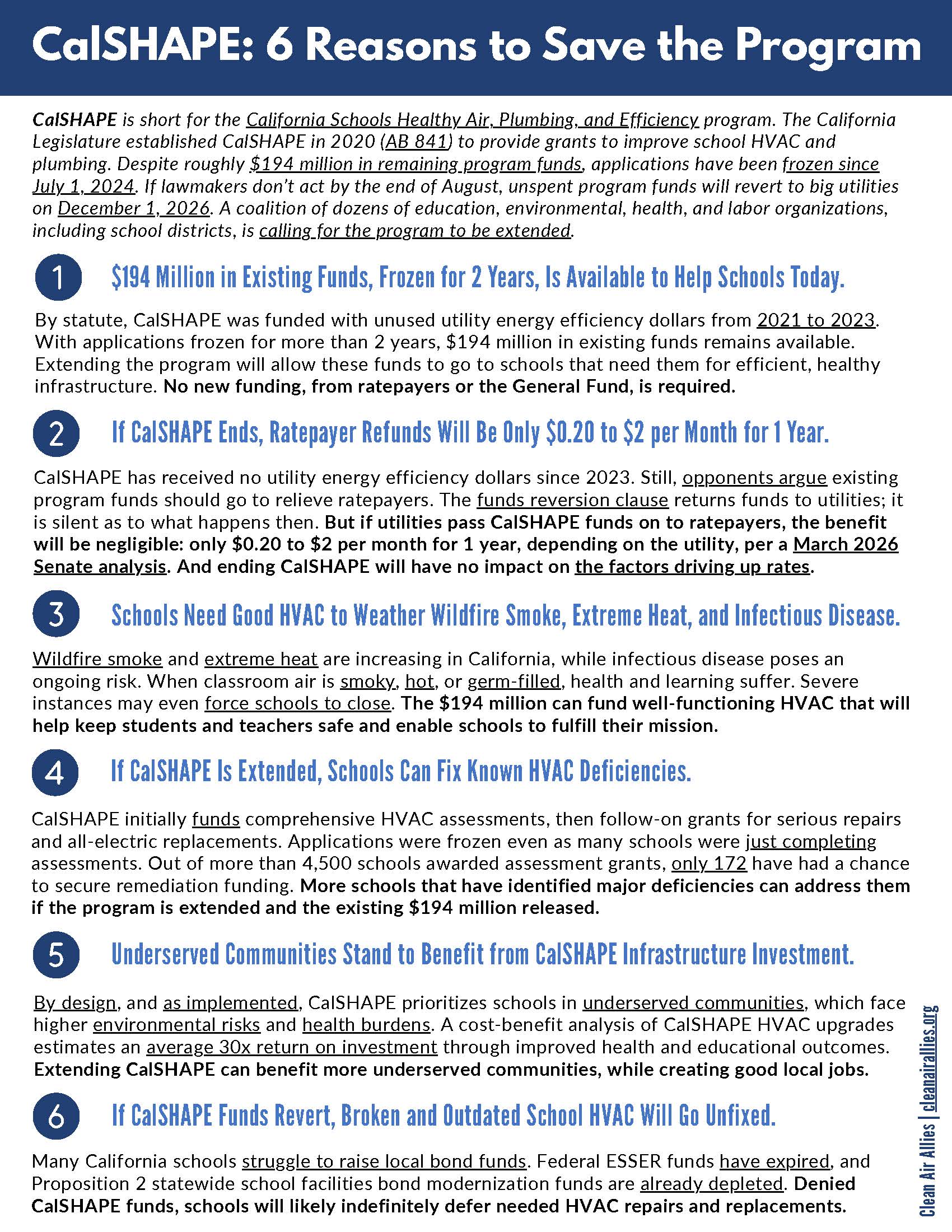
CalSHAPE: Six Reasons to Save the Program
CalSHAPE is short for the California Schools Healthy Air, Plumbing, and Efficiency program. The California Legislature established CalSHAPE in 2020 (AB 841) to provide grants to improve school HVAC and plumbing. Despite roughly $194 million in remaining program funds, applications have been frozen since July 1, 2024. If lawmakers don’t act by the end of August, unspent program funds will revert to big utilities on December 1, 2026. A coalition of dozens of education, environmental, health, and labor organizations, including school districts, is calling for the program to be extended .
1. $194 Million in Existing Funds, Frozen for 2 Years, Is Available to Help Schools Today.
By statute, CalSHAPE was funded with unused utility energy efficiency dollars from 2021 to 2023. With applications frozen for more than 2 years, $194 million in existing funds remains available. Extending the program will allow these funds to go to schools that need them for efficient, healthy infrastructure. No new funding, from ratepayers or the General Fund, is required.
2. If CalSHAPE Ends, Ratepayer Refunds Will Be Only $0.20 to $2 per Month for 1 Year.
CalSHAPE has received no utility energy efficiency dollars since 2023. Still, opponents argue existing program funds should go to relieve ratepayers. The funds reversion clause returns funds to utilities; it is silent as to what happens then. But if utilities pass CalSHAPE funds on to ratepayers, the benefit will be negligible: only $0.20 to $2 per month for 1 year, depending on the utility, per a March 2026 Senate analysis. And ending CalSHAPE will have no impact on the factors driving up rates.
3. Schools Need Good HVAC to Weather Wildfire Smoke, Extreme Heat, and Infectious Disease.
Wildfire smoke and extreme heat are increasing in California, while infectious disease poses an ongoing risk. When classroom air is smoky, hot, or germ-filled, health and learning suffer. Severe instances may even force schools to close. The $194 million can fund well-functioning HVAC that will help keep students and teachers safe and enable schools to fulfill their mission.
4. If CalSHAPE Is Extended, Schools Can Fix Known HVAC Deficiencies.
CalSHAPE initially funds comprehensive HVAC assessments, then follow-on grants for serious repairs and all-electric replacements. Applications were frozen even as many schools were just completing assessments. Out of more than 4,500 schools awarded assessment grants, only 172 have had a chance to secure remediation funding. More schools that have identified major deficiencies can address them if the program is extended and the existing $194 million released.
5. Underserved Communities Stand to Benefit from CalSHAPE Infrastructure Investment.
By design, and as implemented, CalSHAPE prioritizes schools in underserved communities, which face higher environmental risks and health burdens. A cost-benefit analysis of CalSHAPE HVAC upgrades estimates an average 30x return on investment through improved health and educational outcomes. Extending CalSHAPE can benefit more underserved communities, while creating good local jobs.
6. If CalSHAPE Funds Revert, Broken and Outdated School HVAC Will Go Unfixed.
Many California schools struggle to raise local bond funds. Federal ESSER funds have expired, and Proposition 2 statewide school facilities bond modernization funds are already depleted. Denied CalSHAPE funds, schools will likely indefinitely defer needed HVAC repairs and replacements.