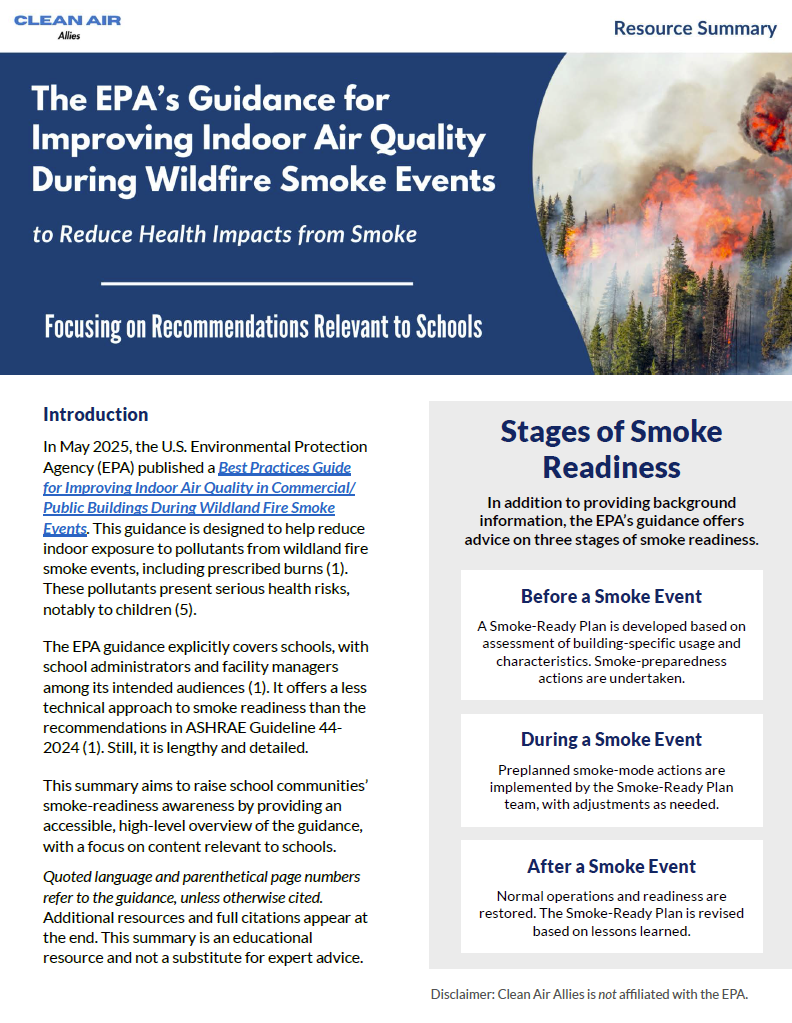
RESOURCE SUMMARY: the EPA’s Guidance for Improving Indoor Air Quality During Wildfire Smoke Events
Wildfire smoke events are increasing, with adverse human health impacts. Children are at particular risk. Does your school have a Smoke-Ready Plan? This resource summary provides an overview of actions the EPA recommends for building readiness before, during, and after wildfire smoke events.
The EPA’s Guidance for Improving Indoor Air Quality During Wildfire Smoke Events to Reduce Health Impacts from Smoke, Focusing on Recommendations Relevant to Schools
Clean Air Allies Resource Summary
Written by JuNelle Harris
Published August 2026
According to NASA satellite data over a 21-year span, “extreme wildfires have become more frequent, more intense, and larger.” Wildfires are projected to increase in many parts of the United States in coming years.
Because smoke can travel hundreds or thousands of miles, people far away from wildfires are experiencing poorer air quality. For example, in 2023, a MMWR article reported a 17% increase in asthma-associated emergency room visits across age groups and U.S. regions, due to smoke from wildfires in Canada.
Based on data from Stanford University’s Environmental Change and Human Outcomes Lab, it has been estimated that “per-person exposure to harmful wildfire smoke in the U.S. was four times higher during 2020-2024, on average each year, than during 2006-2019.”
People are advised to stay inside during smoke events. But if buildings are leaky, pollutants from smoke like particulate matter (PM) and volatile organic compounds (VOCs) can end up in indoor air, too.
Children as a population are at greater risk of negative health impacts from wildfire smoke. They inhale more air than adults relative to body weight, into still-developing lungs.
Because children, and the adults who teach and care for them, spend thousands of hours in school, ensuring that the indoor air they breathe there is safe from wildfire smoke is critical.
In May 2025, the U.S. Environmental Protection Agency (EPA) published a Best Practices Guide for Improving Indoor Air Quality in Commercial/Public Buildings During Wildland Fire Smoke Events. The guidance recommends best practices to protect building occupants, including those in schools, from indoor exposure to wildfire smoke pollution.
Schools come in many shapes and sizes. Fortunately, the EPA’s best practices can be applied in a variety of building types, including those with central HVAC systems, standalone HVAC units, or no HVAC.
An organizing best practice is the adoption and refinement of a building-specific Smoke-Ready Plan, which the guidance defines as a “list of actions to take before, during, and after a smoke event.” At each stage, a designated smoke-ready team implements a range of appropriate actions.
Clean Air Allies’ resource summary synthesizes nearly 80 pages of detailed EPA recommendations about smoke-readiness planning and actions into a concise 8-page overview focused on content relevant to schools. It is accompanied by a list of additional smoke-readiness resources, including ones specific to schools. It also includes numerous parenthetical page citations to aid navigation of the guidance.
Beyond the smoke-ready planning process, topics previewed include:
- health risks from smoke
- smoke information sources
- building assessment and adjustments
- HVAC systems settings and filters
- portable air cleaners
- cleaner air rooms and centers
- air quality sensors
Taking steps to improve schools’ smoke readiness can help protect occupants from health risks associated not only with smoke but also with other air pollution, airborne viruses, water intrusion, and pests. Other potential benefits include increased efficiency and reduced energy costs.
This is Clean Air Allies’ second resource summary. The first, Resource Summary of the CDC’s Guidance for Preventing Infections in K-12 Schools, was published in December 2025.
Our resource summaries are intended to raise awareness about why and how school indoor air quality (IAQ) should be improved by introducing authoritative resources to school communities in an accessible way.