CalSHAPE
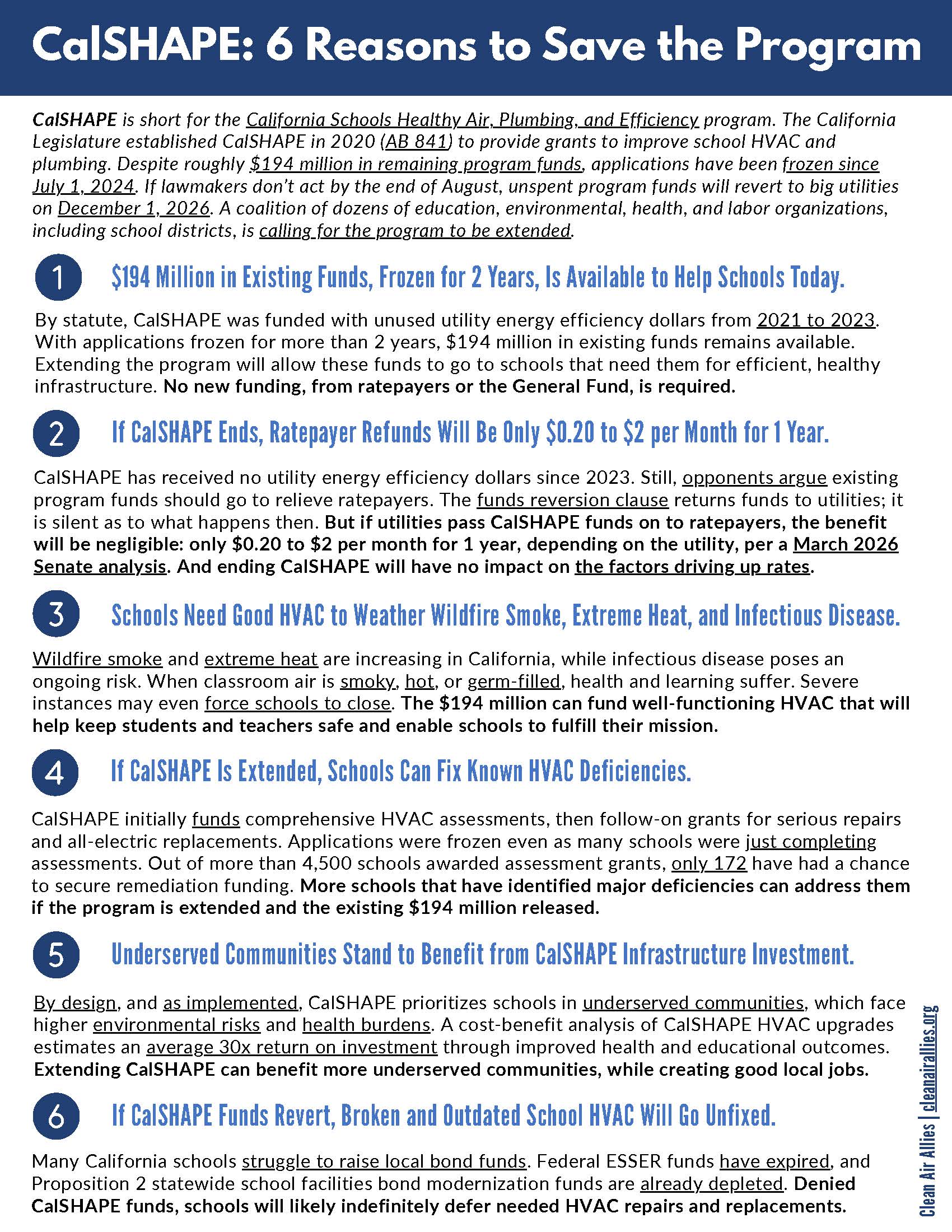
To date, Clean Air Allies’ advocacy for the California school HVAC grant program, CalSHAPE, has helped protect more than $100 million in funding for school indoor air quality improvements.
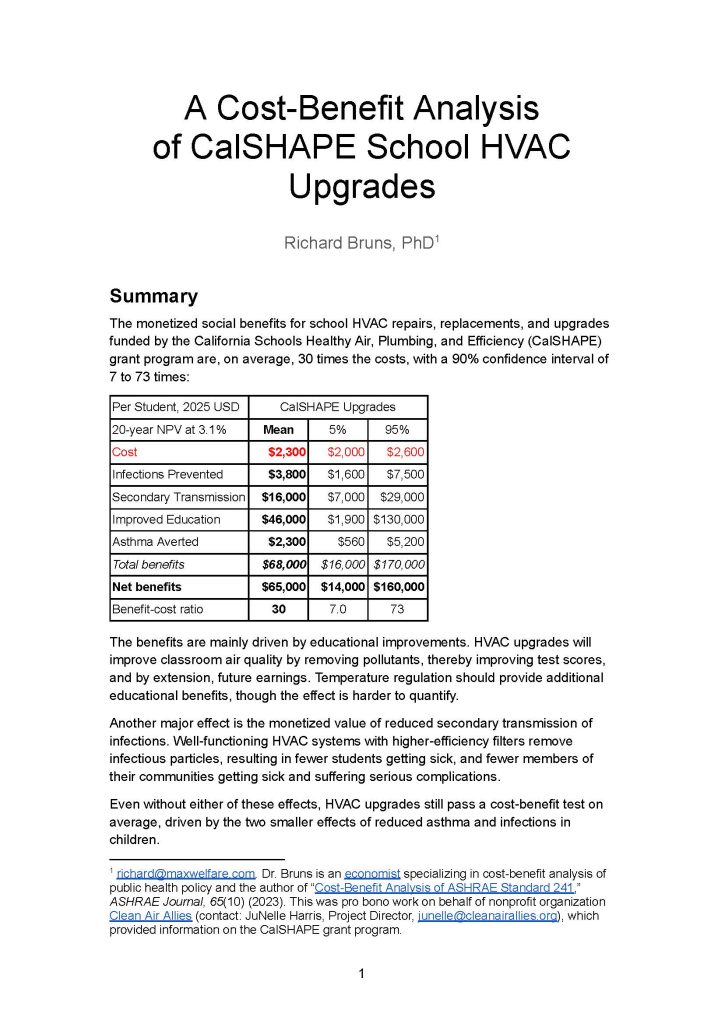
A pro bono economic analysis commissioned by Clean Air Allies found that CalSHAPE-funded school HVAC upgrades yield an average 30x return on investment.
Background
Students and staff in California’s TK-12 public schools spend thousands of hours in buildings that depend on functioning heating, ventilation, and air conditioning (HVAC) systems for healthy, comfortable air. Since 2021, CalSHAPE, the California Schools Healthy Air, Plumbing, and Efficiency program, has been the state’s main source of funding for school indoor air quality (IAQ) and HVAC improvements.
The program was established by AB 841 (Ting, 2020) and is administered by the California Energy Commission (CEC). At least 25% of program funds must go to schools in underserved communities, with additional prioritization of those near busy traffic corridors or Clean Air Act Title V facilities. As of the end of 2024, 50% of HVAC funding has gone to underserved communities. Unlike statewide bond funding, which has been criticized for being inequitable, CalSHAPE provides 100% grant funding, so under-resourced communities do not have to raise matching funds.
Since fall 2023, Clean Air Allies (formerly the California Alliance for Clean Air in Schools) has been involved with CalSHAPE outreach and advocacy. A timeline detailing some of these efforts appears below.
Why Is CalSHAPE Important for School IAQ?
CalSHAPE is important from an indoor air quality (IAQ) advocacy perspective for at least two reasons.
First, it funds the collection of significant amounts of data about IAQ in TK-12 public schools through its comprehensive HVAC assessment and classroom CO2 monitor installation components.
Second, it overcomes a major barrier to better IAQ in schools, especially ones in underserved communities, by paying for HVAC system improvements.
How Does CalSHAPE Work?
The program was designed to have two phases. Phase 1, Assessment & Maintenance (A&M) provided noncompetitive grants that pay for public TK-12 schools to:
- conduct comprehensive HVAC assessments, along with maintenance and minor repairs, using qualified, independent technicians
- adopt high-efficiency MERV 13 filters if feasible
- install classroom CO2 monitors
After completing Phase 1, schools are eligible for Phase 2 Upgrade & Repair (U&R) grants to complete serious HVAC repairs, replacements, and upgrades recommended by a licensed professional based on the initial assessments. HVAC systems funded by Phase 2 must ordinarily use all electric equipment.
Why Has CalSHAPE Funding Been in Jeopardy Since 2024?
Unfortunately, of the more than 4,500 schools that have received Phase 1 grants since fall 2021, only 172 have been able to proceed to Phase 2 to remediate serious deficiencies. Program applications have been frozen since July 1, 2024, due to efforts to repurpose its funds. At that time, only a small fraction of schools had been able to finish Phase 1 and move on to apply for Phase 2, despite roughly $194 million in remaining program funds.
Because CalSHAPE was funded primarily by three years’ worth of contributions, from 2021—2023, from the energy efficiency budgets of investor-owned utilities (IOUs), it has become embroiled in broader state-level debates about utility affordability and what if any programs should be ratepayer-funded. This has led to efforts, beginning in 2024, to revert unencumbered program funds to the IOUs despite significant unmet school HVAC needs. As a result, Clean Air Allies pivoted from outreach, to build awareness of and promote school district participation in CalSHAPE, to defending it. Throughout, we have developed and widely shared deep subject-matter expertise around the program.
In mid-2024, Clean Air Allies helped mobilize a coalition that succeeded in defeating AB 3121 (Petrie-Norris, 2024), which would have reverted all unencumbered program funds to IOUs. As a result, approximately $160 million in program funds were distributed to school districts that had managed to apply by July 1, 2024.
Despite this victory, reapplications were not reopened. Meanwhile, existing statutory clocks — a December 1, 2026 funds reversion date and January 1, 2027 sunset date — continued ticking. In 2025, a bill to extend these deadlines, AB 832 (Muratsuchi, 2025), failed when the chair of the Assembly Utilities and Energy Committee refused to even allow a public hearing on the bill.
As of August 2026, Clean Air Allies is actively involved in a coalition making a final effort to get the remaining $194 million or so in funds to schools by extending program deadlines through the budget process.
What Has Clean Air Allies Learned from Working on CalSHAPE?
Clean Air Allies’ outreach and advocacy efforts around CalSHAPE have offered a valuable education in coalition building, policymaking, and the dynamics involved in implementing school IAQ measures at scale. Sadly, they have also underscored the extent to which school IAQ still has relatively low salience as an issue among policymakers and the public, despite the multifaceted benefits of investing in school HVAC improvements:
- healthier and more comfortable daily environments for students and teachers
- lower chronic disease-related burden, e.g., from asthma
- reduced infectious disease transmission in schools and communities
- improved educational outcomes
- enhanced school resilience against closure due to extreme heat, precipitation, and wildfire smoke events
- greater energy efficiency
- reduced pollution from fossil-fueled HVAC equipment
- more high-quality jobs
Some of these benefits are quantified or otherwise discussed in a program cost-benefit analysis conducted pro bono by public health economist Dr. Richard Bruns for Clean Air Allies. Others are recognized in legislative findings and declarations in the authorizing statute.
Clean Air Allies CalSHAPE Advocacy and Outreach Timeline
Fall 2023
- Clean Air Allies begins CalSHAPE outreach
Winter 2024
- Clean Air Allies consults with CEC staff to better understand the program to guide outreach efforts
- Clean Air Allies’ advocacy contributes to amendment of AB 691 to extend program deadlines
Spring 2024
- Clean Air Allies engages in targeted CalSHAPE outreach to school districts and community stakeholders
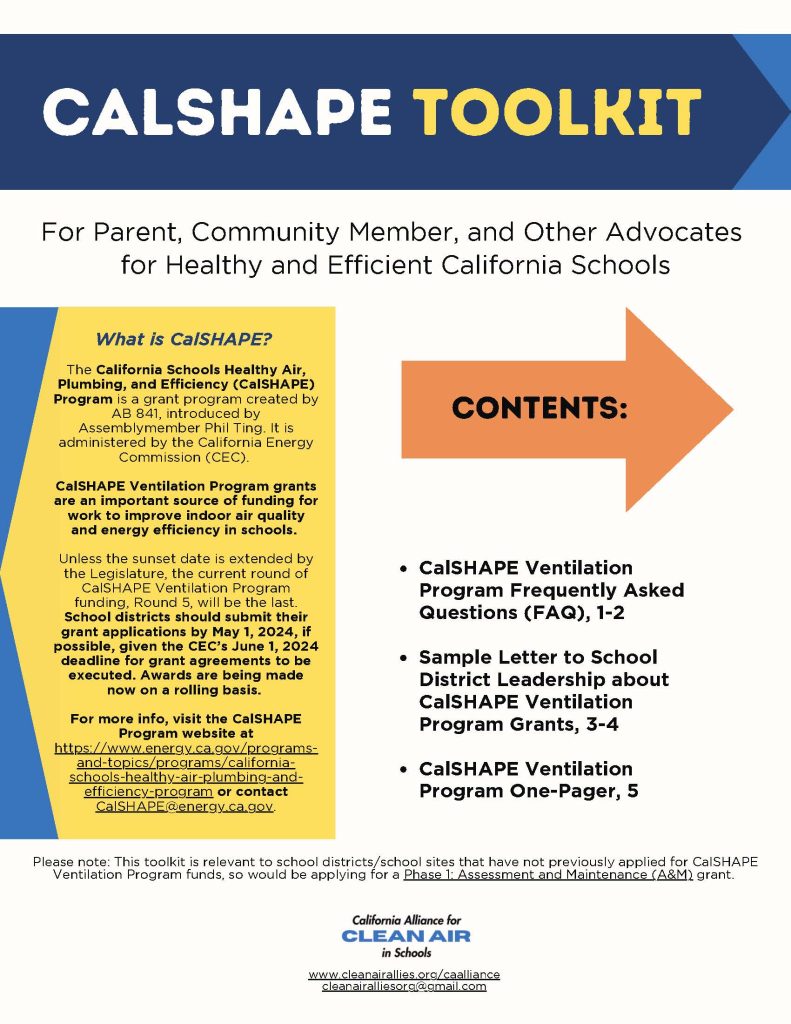
- Clean Air Allies releases a CalSHAPE Toolkit with FAQs and a sample letter that can be used to encourage school districts to apply
- Partners share the CalSHAPE Toolkit
- AB 691 stalls after IOU opposition
July 2024
- When program applications are abruptly closed, Clean Air Allies learns of plans to revert unencumbered funds to IOUs and alerts other stakeholders
- Clean Air Allies drafts a letter calling upon CEC to reopen applications; more than two dozen other organizations sign on, helping to mobilize a coalition

August 2024
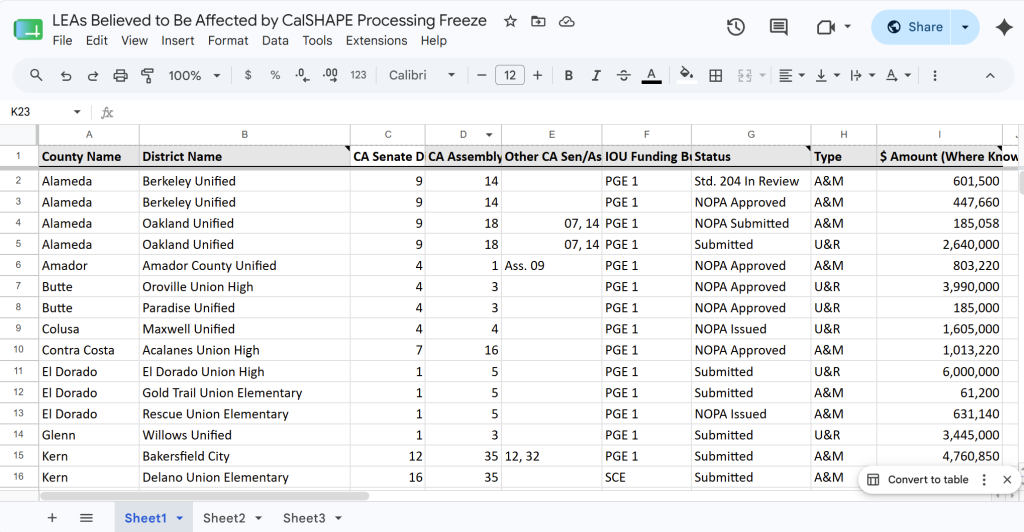
- Using public records data obtained from CEC, Clean Air Allies creates a publicly accessible spreadsheet of more than 80 school districts with pending CalSHAPE grant applications, and documents school district reaction to the abrupt closure of applications
- Clean Air Allies provides subject-matter expertise to other coalition members and the media, including reporters at Politico and CalMatters
- Clean Air Allies is active in advocacy efforts that lead to the unexpected defeat of AB 3121, which would have reverted an estimated $350 million plus in unencumbered program funds
September—December 2024
- Clean Air Allies drafts a coalition letter, again calling on CEC to reopen CalSHAPE applications
- While applications are not reopened, thanks to the defeat of AB 3121, school districts that applied by July 1, 2024, have their applications processed, resulting in awards estimated to be around $160 million
- Clean Air Allies uses public records requests to track CalSHAPE remaining funds
January—June 2025
- Clean Air Allies provides subject-matter expertise to coalition members and legislative staff in relation to AB 832, which would have extended CalSHAPE program deadlines, but failed when the Assembly Utilities and Energy Committee chair refused to schedule it for public hearing
- Clean Air Allies uses public records requests to track CEC processing of grantee HVAC assessment reports
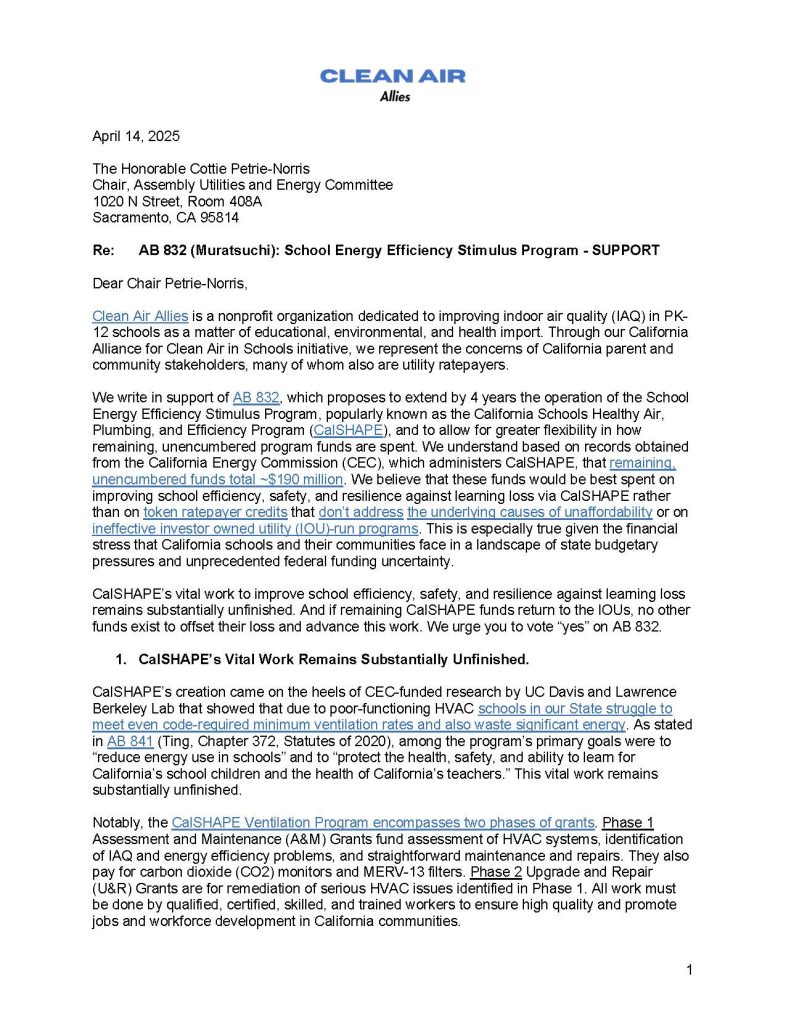
- Clean Air Allies writes a letter in support of AB 832
- Clean Air Allies is mentioned in stories on CalSHAPE in Politico and ABC7 Los Angeles
- Clean Air Allies works with other coalition members to oppose Trailer Bill RN 25 15913, which would have repurposed approximately $194 million in remaining CalSHAPE funds
October 2025—February 2026
- Clean Air Allies works with other coalition members on efforts to extend CalSHAPE program deadlines and on possible funding through the Greenhouse Gas Reduction Fund (GGRF)
March 2026
- Clean Air Allies drafts sample language amending a pending trailer bill to extend CalSHAPE program deadlines
- On behalf of a coalition supporting extension of CalSHAPE program deadlines, Clean Air Allies takes the lead in drafting a sign-on letter that ends up being signed by more than three dozen education, environmental, health, and labor organizations

April 2026
- Clean Air Allies provides subject-matter expertise in relation to, and is mentioned in, an Orange County Register article on schools’ need for HVAC and CalSHAPE
- Clean Air Allies prepares FAQs related to the program
- Clean Air Allies coordinates with government affairs staff for ASHRAE, which submits a letter in support of CalSHAPE extension
- Clean Air Allies releases a cost-benefit analysis of Phase 2-funded school HVAC upgrades conducted pro bono by public health economist Dr. Richard Bruns

May 2026
- The cost-benefit analysis released by Clean Air Allies is mentioned in a legislator letter in support of extending CalSHAPE program deadlines
- The cost-benefit analysis is also referenced in an LA Times Op Ed on CalSHAPE